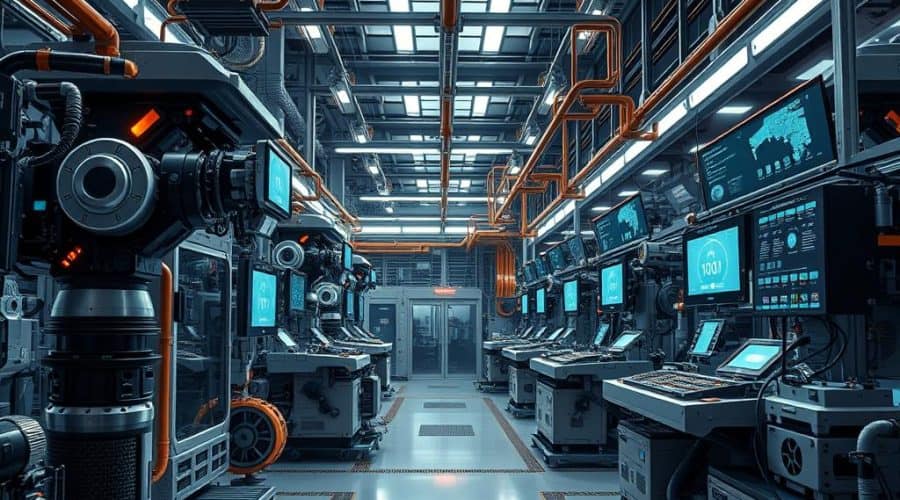
Did you know 28% of US manufacturers are using AI? This shows a big change in the manufacturing world. Companies want to work smarter and save money with AI. AI is making factories more efficient and changing how things are made.
AI helps with things like keeping machines running smoothly and checking product quality. By using AI, manufacturers can do better and stay ahead. In this article, I’ll show how AI is changing manufacturing for the better. It’s making production more innovative and efficient.
Key Takeaways
- 28% of US manufacturers currently utilize AI technologies to enhance operational capabilities.
- AI in manufacturing offers the potential for significant cost reductions and improved efficiency.
- Predictive maintenance can drastically reduce downtime, improving production rates significantly.
- Quality control has been shown to improve defect detection rates significantly with AI.
- The ongoing evolution of smart manufacturing is expected to lead to further automation and optimized designs.
Understanding AI in Manufacturing
AI in manufacturing plays a key role in improving production. It has been slowly adopted due to talent and data shortages. Yet, AI can greatly enhance efficiency, quality, and cost-effectiveness in manufacturing.
What is AI in Manufacturing?
AI in manufacturing means using artificial intelligence to make production smoother. It uses machine learning and data analytics to improve workflows and decision-making. This helps manufacturers solve problems and stay ahead in the market.
Generative AI and synthetic data are now essential. They make AI more accessible, helping tackle specific challenges in manufacturing.
The Role of AI Technologies in Manufacturing Processes
AI technologies automate many tasks in manufacturing. For example, predictive maintenance uses AI to forecast equipment failures, cutting downtime by 30-50%. Companies like Jabil have seen up to 97% accuracy in product inspections with AI.
AI also improves quality control by doing visual inspections better than humans. To fully benefit, companies need to adapt their models. AI can lead to quick wins and better cash flow.
Benefits of AI in Manufacturing
AI in manufacturing has brought big changes. It makes things more efficient, improves quality, and makes production more flexible. Companies are seeing the big benefits these new tools offer.
Increased Efficiency & Cost Savings
AI has made companies more efficient. It automates tasks, saving on labor costs and reducing mistakes. AI’s predictive maintenance cuts maintenance costs by 25% and breakdowns by 70%.
This means less downtime and more production. Studies show AI users save a lot of money. It’s a big win for their bottom line.
Improved Quality Control
AI boosts quality control with advanced tech. It uses machine learning and image processing to spot defects. Factories using AI see a 50% boost in productivity and 90% accuracy in defect detection.
This leads to less waste and happier customers. It’s key in a competitive market. High-quality products are what customers want.
Enhanced Flexibility in Production
AI makes production more flexible. It lets companies quickly change with demand. Machine learning analyzes data in real-time, making adjustments fast.
This flexibility reduces risks of overproduction or shortages. It helps manage inventory better. Companies can handle market changes more easily.
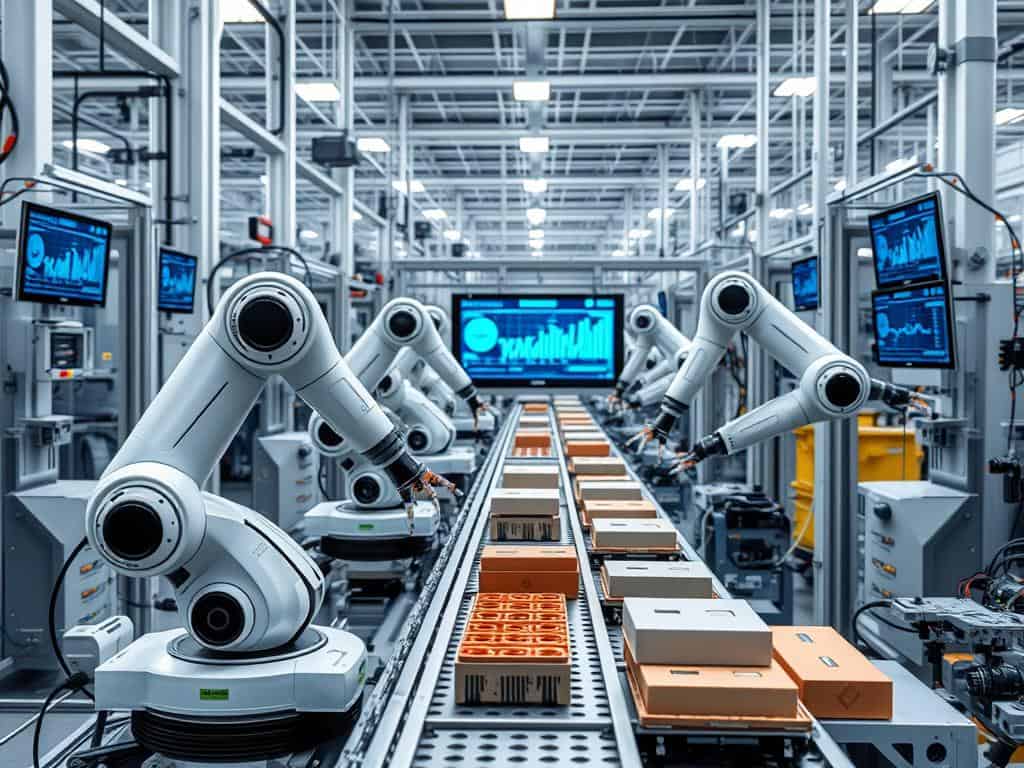
AI in Manufacturing: Real-World Applications
Exploring AI in manufacturing, I’m amazed by its many uses. From predictive maintenance to smart supply chain management, AI is changing how we make things. It’s making old ways of making things better.
Predictive Maintenance and Its Impact
Predictive maintenance is a big deal in AI. It uses data from sensors to predict when machines might break. This lets manufacturers fix things before they fail, making things run smoother.
Reports show that using predictive maintenance can cut down on unexpected downtime. This makes production more reliable and efficient.
AI-Driven Quality Inspection Systems
AI is also key in keeping products up to standard. It uses computer vision and machine learning to check products fast. This means spotting defects sooner, saving money and improving quality.
High-tech cameras and AI work together to check products as they’re made. Only perfect products move on, cutting down on waste.
Smart Supply Chain Management
AI also makes supply chains smarter. It looks at past sales and guesses what people will buy next. This helps manufacturers keep the right amount of stock.
Companies like Walmart use AI to manage their supplies better. This keeps products on shelves and saves money.
Robotics and Automation Innovations
AI robots are changing how we make things. They do complex and repetitive tasks, making production faster. In car making, for example, robots do precise jobs like welding.
Robots work with people, making things safer and more efficient. This is a big step forward in making things better.
Conclusion
AI is changing manufacturing in big ways, making it more efficient and flexible. Looking at the future, companies that use AI will see huge gains in productivity and quality. Moving to smart factories, powered by AI and robots, is key for success.
AI is making factories smarter by connecting them through the Internet of Things. This change boosts efficiency and helps companies grow sustainably. It also shows the importance of training workers for these new roles.
But, we need to keep studying AI’s effects on jobs and the environment. Using AI well can help companies run better, reduce waste, and improve quality. I believe AI can help us succeed in a fast-changing world.
