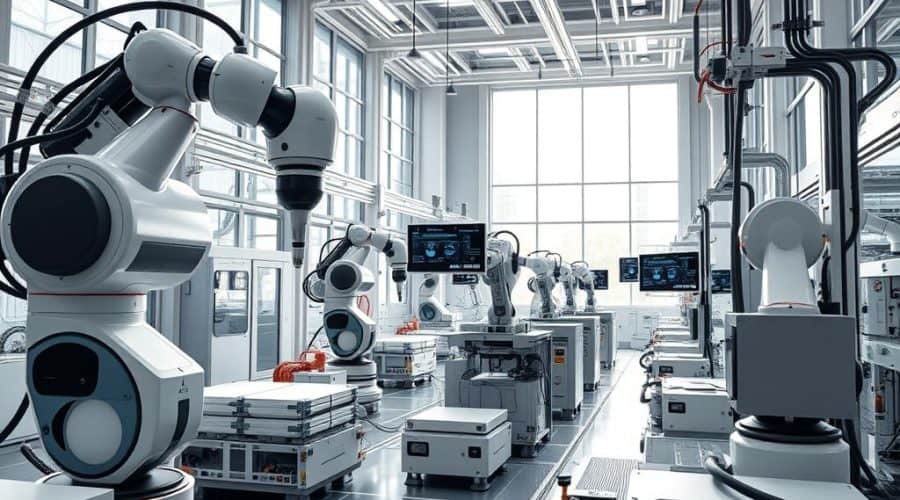
Did you know that up to 70% of manufacturers think smart factory tech will boost their efficiency a lot? This shows a big change in how we make things. Smart factories mix the Internet of Things (IoT) with data analysis and robots. These changes make things better and open new chances for those who adapt fast.
Smart factories collect lots of data from IoT sensors. This helps with fixing things before they break and makes work flow smoother. When old supply chains face problems, smart factories stay strong thanks to data. They make things better and move materials around more efficiently.
In this article, I’ll show you how manufacturing has changed. We’ll look at the key tech that makes smart factories. These changes are making work more efficient and setting us up for a better future.
Key Takeaways
- Smart factories make work better with automation and IoT.
- Collecting data in real-time helps with fixing things and managing production.
- Using advanced software and data analysis gives a competitive edge and helps follow rules.
- Smart manufacturing meets changing consumer needs, like the “Amazon Effect.”
- Artificial intelligence and 5G are shaping the future of smart factories.
- Smart factories help solve supply chain problems during global crises.
Understanding Smart Factories and Industry 4.0
Smart factories come from the big change in manufacturing. They show how we’ve moved from simple machines to complex systems with advanced tech. This change shows how important it is to use new ways and tech in making things.
The Evolution of Manufacturing
Manufacturing has gone through four big changes. The first was in the late 1700s, with water and steam machines for mass production. The second brought electric power and assembly lines for better work. The third used computers and phones for smarter decisions.
Now, we’re in Industry 4.0, where smart tech like IoT, AI, and cloud computing make things better. This phase focuses on making factories smarter and more efficient.
Key Technologies Driving Smart Factories
Many techs are key to making smart factories better. The Industrial Internet of Things (IIoT) gives us real-time info for better work. AI helps with hard tasks, like fixing things before they break, and makes decisions faster.
Cloud computing helps factories work together better and saves money. These techs make factories work better, make products better, and make making things more efficient.
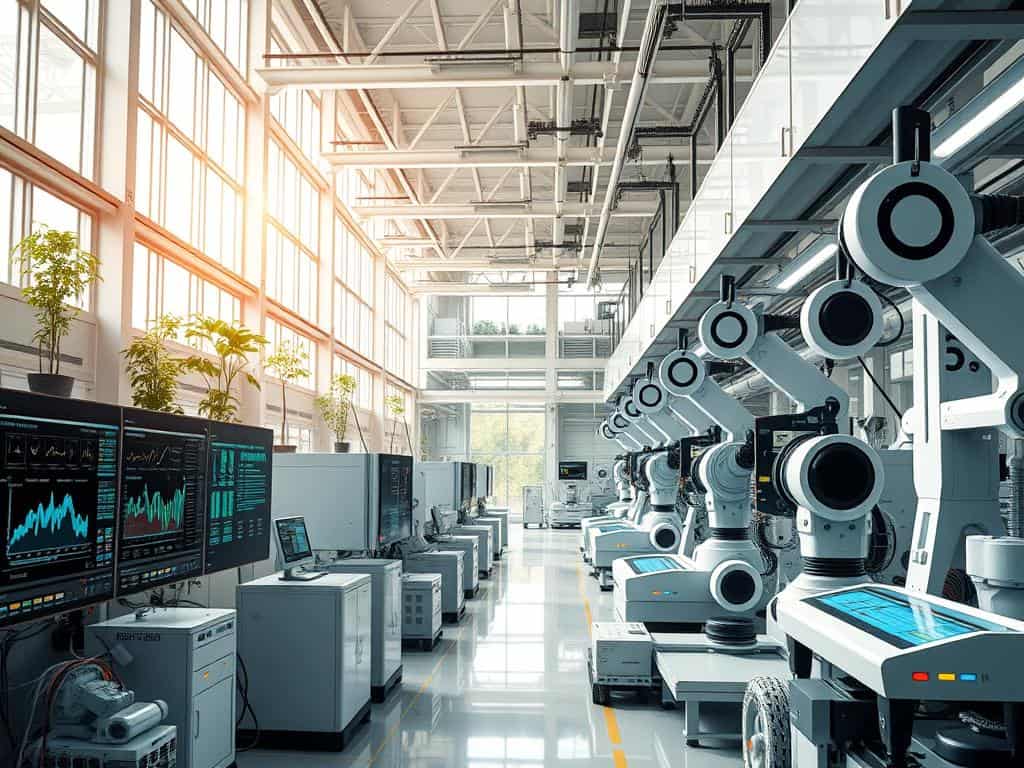
Smart Factories: Transforming Manufacturing Processes
In the world of smart manufacturing, data is key. It helps make processes better and more efficient. Advanced technologies like Industrial IoT (IIoT) sensors collect real-time data. This data comes from various sources, giving a full view of how things work.
By combining this data with past information, smart factories make smarter choices. This leads to better operations and decisions.
Data Acquisition and Analysis
The smart manufacturing market is growing fast. It’s expected to jump from $223.6 billion to $985.5 billion by 2032. This shows how important it is to get data right.
General Electric’s Brilliant Factory uses real-time analytics to improve its operations. This cuts down on downtime and reduces the risk of equipment failure. Big data analytics have helped Bosch increase production efficiency by 25%.
Automation Capabilities in Smart Factories
Automation in manufacturing keeps getting better with AI and machine learning. Siemens uses advanced robotics to automate 75% of its supply chain. This has led to a 99.9% quality standard.
Automation allows for fast and accurate production of over 1,000 product variations every day. Robot and cobot technology now handles 32% of production lines. This shows how automation is becoming more common to boost efficiency and productivity.
Digital twin technology has shown great promise. It has cut maintenance costs by 13% and boosted efficiency by 15%. Augmented reality tools have also increased productivity by 32%.
Companies are now working on real-time networking through data sharing. This creates a system where processes adapt quickly to market needs.
Conclusion
Looking back at our journey into smart factories and Industry 4.0, it’s clear we’re at a turning point. These advancements make manufacturing more efficient and help companies succeed globally. Smart technologies improve how we work, making us more competitive.
Using data analytics and AI, companies can make their production better. They can use less energy and have fewer problems. This change helps them meet market needs quickly, keeping them successful.
Creating standards for robotic systems and machine vision is key. Working together and with groups like the Manufacturing Extension Partnership is important. This helps us learn how to use these technologies well.
As smart factories grow, we’ll learn more about how to keep them running smoothly. This will help us fix problems before they start and keep improving.
Smart factories are not just a choice; they’re essential for staying ahead. With smart strategies, businesses can work better, be more productive, and be sustainable. So, as we move forward, smart factories will be key to manufacturing’s future.
